What to See in Mauritius: The Sites, the Hours and the Fees That Decide Your Day
Updated September 18, 2026 · 8 min read
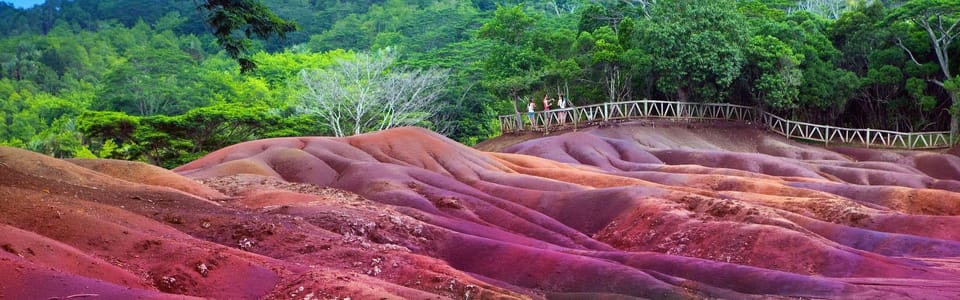
Mauritius is 65 kilometres from north to south, which makes every distance look shorter than it drives. The sights that people actually come for are not spread evenly either: the coloured earth, the mountain, the gorges and the botanic garden sit at four corners of the island, and each one keeps its own hours, sets its own fee and closes on its own terms.
None of that is on the ticket you buy. Here is what the sites themselves publish, and what it means for a day that has to end somewhere.
Chamarel: a ticket, and three kilometres you have to cover yourself
The Seven Coloured Earth at Chamarel is the most-reviewed plain entrance ticket in our inventory — 1,146 reviews for a ticket, with no boat, guide or lunch attached to it.
From the geopark’s own visitor information: adults Rs 800, children aged 5 to 11 Rs 400, under 5 free. Opening hours change with the season — 8.30am to 5.30pm from October to May, with last tickets sold at 5pm, and 8.30am to 5pm from June to September. One ticket covers three things: the two viewpoints over the Chamarel waterfall, the coloured dunes themselves, and the tortoise park.
Two details matter more than the price. It is three kilometres from the entrance gate to the dunes, and there is no shuttle — the geopark states plainly that you need your own transport or you walk it. And climbing down to the waterfall on your own is strictly prohibited — the descent is not part of the ticket, and the geopark points people to accredited hiking guides for it; the viewpoints are the visit. Drones are not allowed either.
That first point is the whole argument for arriving by car or on a tour rather than being dropped at the gate. The entrance ticket costs €17.43 and rates 4.3 stars, which is close to what the gate charges in rupees — it buys you the queue, not the transport.
Most visitors see Chamarel as one stop on a south-western loop. The best-rated of those in our inventory is a private south-west tour with pickup at €110 with 4.9 stars from 1,359 reviews — the highest review count of any private tour we list. Whether that is worth three times the ticket depends entirely on whether you have a car.
Le Morne Brabant: the trail ends at a cross, not at the top
Le Morne Brabant is the basalt monolith on the south-western tip, inscribed by UNESCO in 2008 as a cultural landscape — the mountain where escaped slaves took refuge, and the reason it is a heritage site rather than just a good view.
The Le Morne Heritage Trust Fund publishes the trail figures, and they are more specific than any tour description:
| Section 1 | Section 2 | |
|---|---|---|
| From – to | trailhead – viewpoint 2 | viewpoint 2 – metal cross |
| Distance | 2.53 km | 760 m |
| Elevation | 1.5 m to 260 m | 260 m to 492 m |
| Grade | 1 | 3 |
| Liability form | no | mandatory |
The gate is open 7am to 4pm, every day including public holidays, and the latest time to start climbing is 2.30pm. The Trust Fund asks you to be back at the trailhead by 4pm, before the gate closes, and to enter only at the official trailhead — anyone who goes up elsewhere is not on the visitor record book and not accounted for if something happens.
The hiking trail ends at the metal cross at 492 metres. The peak is 556 metres, and the Trust Fund asks hikers not to climb beyond the cross. If a tour promises you the summit, that is the distinction to ask about.
Section 2 is where the honest warnings sit: a gulley that becomes a watercourse in rain, loose rock, rockfall risk, exposure to wind, no vehicle access in an emergency. A qualified guide is recommended — not required — and the Trust Fund asks people to avoid Section 2 if they are under 13, in poor health or poorly equipped. The trail closes altogether on a heavy or torrential rain warning, from cyclone warning class II, and after landslides.
Two guided options carry the reviews: a UNESCO hike with a local guide at €50, four hours, 4.9 stars from 714 reviews, and a sunrise hike and climb at €65.35 with a perfect 5.0 from 987 reviews; no other 5.0-rated offer in our inventory has been reviewed as often. A sunrise start also solves the heat, which on Section 2 is the real difficulty.
Black River Gorges: free, and the only place with 60 kilometres of choice
The National Parks and Conservation Service gives the park as 6,574 hectares of forest, containing Piton de la Rivière Noire at 828 metres — the highest point in Mauritius — and some 60 km of trails. Entry is free. There is no ticket to buy and nothing to book.
That makes it the cheapest full day on the island and the one that asks the most of you: the trails range from around 3 km to 14 km return, they are signposted rather than guided, and the forest is where the endemic species that survived are. If you want the interior of Mauritius rather than its lagoon, this is it. Guided hikes exist and are the sensible option in wet weather, when the trail surfaces here behave much like Le Morne’s Section 2.
Nearby and equally inland, Tamarind Falls — the seven cascades above Henrietta — runs three hours at €50 with 4.9 stars from 613 reviews. Our nature and hiking pages collect the rest, 132 offers from €17.43.
Pamplemousses: the one that never closes
The Sir Seewoosagur Ramgoolam Botanic Garden at Pamplemousses is open Monday to Sunday including public holidays, 8.30am to 5.30pm — the only major site on this list with no weekly closing day.
The fees, from the garden’s own visitors’ information: Rs 300 for non-Mauritians aged 5 and above without a residence permit, Rs 25 for residence-permit holders, free under 5. Mauritian citizens pay Rs 25, and nothing at all on Sundays and public holidays. A photo or film session is charged separately at Rs 2,500 a day for up to ten people — worth knowing if you were planning a shoot among the giant water lilies.
Pamplemousses sits in the north, close enough to Port Louis that the two make one day. The street food and city tour is the other half of it.
The two facts that reorder a Mauritius itinerary
Winter hours are shorter, and they are the hours most visitors get. Chamarel closes half an hour earlier from June to September — the peak of the European season. Le Morne’s 2.30pm cut-off does not move, but in July the light does.
The free sites have no gate, and the paid ones have an inner distance. Black River Gorges asks nothing and gives you 60 km of trail; Chamarel asks Rs 800 and then asks for three kilometres of your own transport. Budget for the second, not the first.
What this island does not do is compress. Two of these four sites in one day is comfortable, three is a drive, four is a mistake. If you only have one inland day, the south-western corner holds Chamarel and Le Morne within twenty minutes of each other — which is why almost every full-day excursion on the island goes there.
Then there is the water, which is a different article: which boat to take to Île aux Cerfs, where the law lets you snorkel in Blue Bay, and the morning window in which swimming with dolphins is legal at all. The lagoon has rules the mountains do not.