Swimming with Dolphins in Mauritius: Six in the Morning to Noon, Three People in the Water
Updated September 18, 2026 · 8 min read
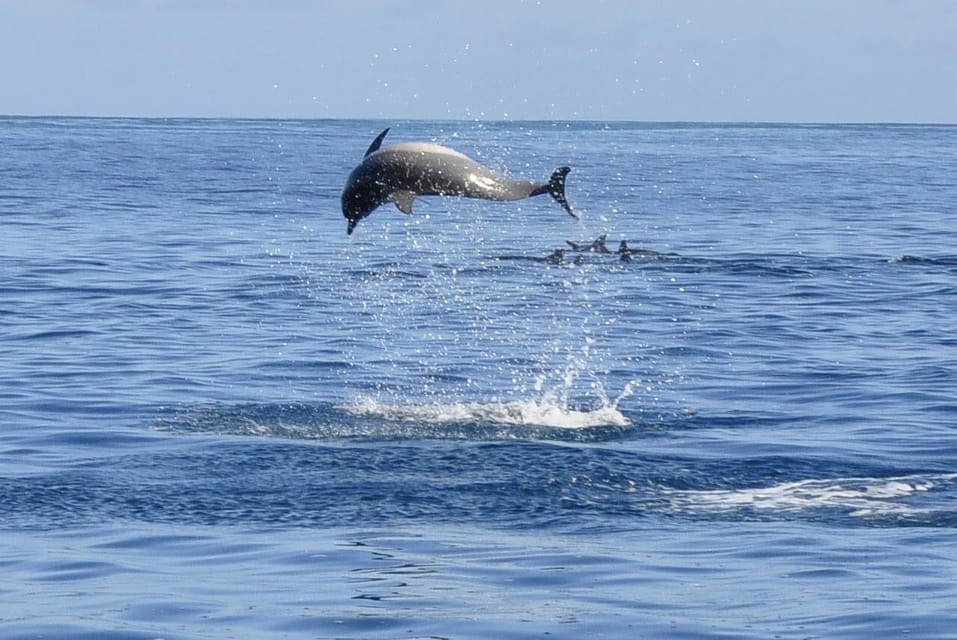
Tamarin Bay on the west coast is where this happens. The boats leave in the dark, the pods of spinner dolphins come inshore to rest in the morning, and by late morning the bay is empty of both.
That pattern is not a habit of the operators. It is the law, and it is unusually specific: the Tourism Authority (Dolphin and Whale Watching) Regulations 2012 set the hours, how a boat may approach, how close it may come and how many people may be in the water. Almost none of it appears in a tour listing.
The hours: 6am to noon, and that is the whole window
The regulations forbid providing dolphin and whale watching for a fee at any time other than 6am to noon.
For the version where you get into the water, the original 2012 text was stricter still — 6am to 9am. It was amended in the same year: the Tourism Authority (Dolphin and Whale Watching) (Amendment) Regulations 2012, made on 18 December 2012, deleted “09.00 hours” and replaced it with “noon”.
So both activities now run 6am to noon, and neither may be sold outside those hours. This matters in two directions. Secondary sources still quote the pre-amendment window of 6am to 9am for the swim, which is not what the regulation says today — and any operator offering you an afternoon dolphin swim is offering something the law does not allow them to sell.
The practical consequence is the pickup time. A trip that puts you in the water needs the boat out early, so a 5.30am or 6am hotel pickup on the west coast is not the operator being dramatic.
Three swimmers, one of whom is the lifesaver
This is the rule that changes what a full boat feels like:
No person in charge of a pleasure craft shall allow more than 3 swimmers, including a life-saver, to enter, dive or snorkel simultaneously in the sea.
Three, and one of them is the crew’s lifesaver. That means two paying guests in the water at a time. If there are twelve people on your boat, you are taking turns — and the pod decides how long the turns last, because it is moving.
Anyone describing a dolphin swim as a group going in together is describing something that is not permitted. Ask how many guests the boat takes before you book; that number divided by two is how many rotations the skipper has to fit into the morning.
The same regulation lists what has to be on board before anyone may get in: a lifesaver, a first aid kit and an oxygen kit, an approved flotation device worn by the lifesaver, the Alpha flag displayed (white and blue, at least 60 cm by 30 cm), a signed disclaimer from each swimmer, and a briefing on calm, silent swimming technique beforehand. Boats for the swim version also need an approved propeller guard and public liability insurance.
The distances, and how a boat must behave
The regulations draw two rings around every animal:
| Prohibited zone | Regulated zone | |
|---|---|---|
| Dolphin | within 50 m of the closest animal | 50 m to 150 m |
| Whale | within 100 m of the closest animal | 100 m to 200 m |
No craft may be operated inside the prohibited zone at all. Inside the regulated zone the boat must run at no-wake speed, enter and leave at no-wake speed, keep the engine in neutral when stopped, and hold a steady course and speed when dolphins are bow-riding.
It must approach from the side and on a course parallel to the animal. Approaching from behind or head-on is prohibited, as is circling, driving through a pod, feeding, throwing anything near the animals, touching them, or making noise to attract them.
Read together, those two things explain the whole experience: the boat sets you down beside the pod’s line of travel and you swim, rather than the boat delivering you into the middle of them. A skipper who does it properly looks less impressive than one who does not.
Whales are a different animal in law
You may not swim, dive or snorkel with a whale. Full stop — it is one of the outright prohibitions in regulation 8, with no permitted-hours exception attached to it.
The Tourism Authority found this worth restating in a communiqué dated 5 July 2024, reminding skippers that it is an offence to allow persons on board their craft to swim, dive or snorkel with whales while conducting dolphin and whale watching.
Which is why a listing titled “dolphin swim and whale watching” is describing two different things: you can be in the water with dolphins, and you watch whales from the boat. A Black River speedboat trip at €110 with 4.6 stars from 713 reviews is exactly that combination, and the distinction is the law’s, not the operator’s.
What it costs, and where it leaves from
Our inventory holds 47 dolphin trips, from €38.22, median €95, with 7,751 reviews between them.
| Trip | From | Price | Stars | Reviews |
|---|---|---|---|---|
| Dolphin snorkel, Crystal Rock, Île aux Bénitiers with lunch | Tamarin | €59.04 | 4.4 | 1,201 |
| Swim and snorkel with dolphins by speedboat | Tamarin | €38.22 | 4.4 | 250 |
| Dolphin swim and whale watching | Black River | €110.00 | 4.6 | 713 |
| Swim with dolphins by speedboat with lunch | Black River | €63.00 | 4.3 | 309 |
| Catamaran cruise with dolphin watching and BBQ | La Gaulette | €75.81 | 4.7 | 305 |
The most-reviewed of them, the Tamarin trip to Crystal Rock and Île aux Bénitiers, runs six and a half hours at €59.04 — and only the first part of that can be the dolphins, because the permitted window ends at noon. The rest is the lagoon off Le Morne, Crystal Rock and lunch on the islet. If the dolphins are the only reason you are booking, a shorter speedboat trip at €38.22 covers the same animals without the rest of the day attached.
When not to book this
If you cannot be in a boat before sunrise, don’t. The window closes at noon, and the dolphins are usually inshore early in it.
If you need a guarantee, don’t. These are wild animals in open water with a 50-metre exclusion ring around them. Every honest operator sells a morning on the water, not an encounter.
And if two minutes with your head underwater is not the point, the money goes further elsewhere: the protected lagoon in the south delivers far more fish per hour, with its own set of rules. And the catamaran cruises along the same west coast show you dolphins from the deck without anyone getting into the water — a different product, sold under the same morning window.