Water Sports in the Mauritian Lagoon: Real Durations, and the Rules Nobody Mentions
Updated September 18, 2026 · 7 min read
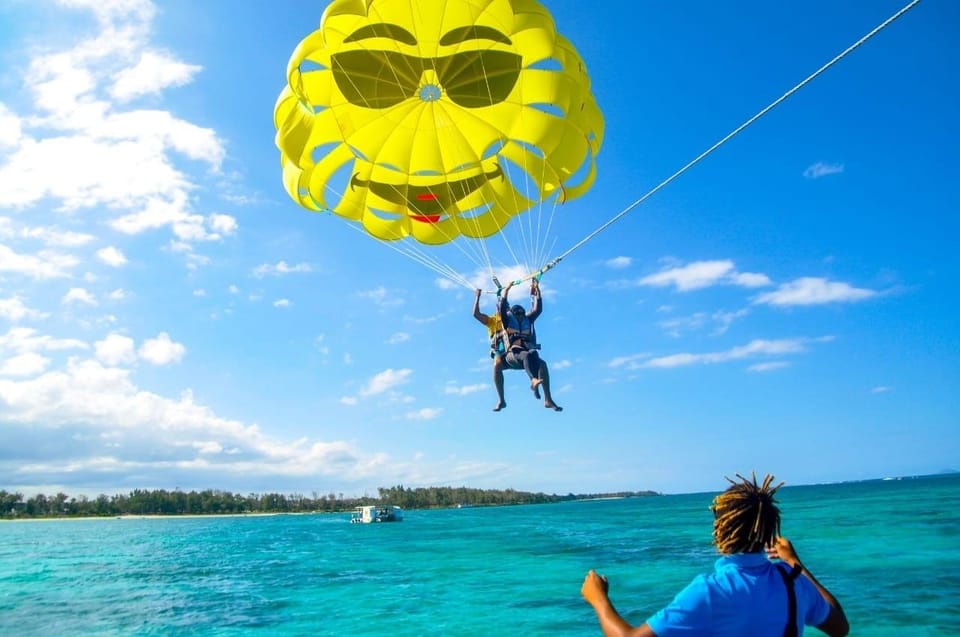
Three things get sold on every beach on the east and north coasts: an undersea walk, a parasailing flight, and a ride on an inflatable tube behind a speedboat. They are usually priced as a package, and the package is almost always shorter than people expect.
The second thing nobody mentions is that parts of this lagoon are regulated water, and the rules are specific enough to be worth knowing before you hire anything.
What you actually get, in minutes
The reference here is a three-activity package at Belle Mare — undersea walk, parasailing and tube ride — at €67 with 4.3 stars from 183 reviews. The operator’s own breakdown:
| Time in it | |
|---|---|
| Undersea walk (helmet diving) | 15–20 minutes on the sand bed |
| Parasailing flight | 3–4 minutes, about 800 feet of line out |
| Tube ride | one run behind the speedboat |
| Whole package, start to finish | 1 hour 30 minutes |
Twenty minutes underwater and four minutes in the air is the honest figure, and it is not a complaint about that operator — it is what these activities are everywhere on the island. The hour and a half is mostly kitting up, boat transfers and waiting your turn. If you book expecting an afternoon, you have booked the wrong thing; if you book expecting one vivid quarter of an hour on the seabed with fish eating out of your hand, that is exactly what it is.
Two details from the same listing that change who should book it: the operator states the activities are suitable for non-swimmers as well, and that a signed waiver may be required before you take part. They also say it is not recommended for anyone with a severe medical condition — which is a matter for your own doctor, not for us and not for the beach operator.
The paddling alternatives are longer and cheaper per hour. The Amber Island kayak expedition is three hours at €54 with 4.9 stars from 632 reviews; a guided kayak tour on the Tamarin River is €47. If you want depth rather than surface, our 13 diving offers start at €70 with a median of €135, and a submarine to the Star Hope wreck off Trou aux Biches runs €135.93.
Inside a marine park, the water has zones
Mauritius has marine parks — Blue Bay in the south-east and Balaclava in the north-west — and inside them the Fisheries and Marine Resources (Marine Protected Areas) Regulations 2001 divide the lagoon into named zones. The rules that follow apply in those parks, not to every beach on the island:
- You may only swim in a swimming zone. The regulations put it flatly: no person shall swim elsewhere in a marine protected area. A swimming zone is marked on its seaward side by a line of yellow floats.
- No craft inside the swimming zone — not a motorboat, and equally not a kayak, pedalo or surfboard.
- No swimming, snorkelling or diving in a traffic lane, the marked channel motorboats use to come in and out.
- Water skiing only in a ski lane, only with a permit from the Permanent Secretary, and only at the times in the published schedule. Outside a ski lane it is not allowed at all.
- Three knots and no wash in the conservation, strict conservation, traffic and mooring zones. Anchoring is only allowed in a mooring zone.
- A boat with snorkellers or divers in the water must fly the A-flag, and may not stay on a dive mooring buoy for more than 90 continuous minutes.
The penalties are in the same regulations: a fine of not less than Rs 2,000 and not more than Rs 20,000 on a first conviction, rising to Rs 35,000–50,000 and up to two years’ imprisonment on a third. Those fall on the operator, not usually on you — which is why a licensed boat behaves differently from a man with a jet ski on the beach, and why it is worth asking whose permit you are on.
The 500-metre rule that applies everywhere
One rule reaches beyond the marine parks. Under the dolphin and whale watching regulations, nobody may knowingly kite surf, jet ski, paraglide, dive or windsurf within 500 metres of the nearest dolphin or whale.
On the west coast that is not theoretical. The bay at Tamarin has resident dolphins most mornings, and Le Morne’s reef break sits in the same stretch of coast that the dolphin boats work. If a pod comes through while you are on the water, the distance is your obligation, not the animals’. The rest of that framework — including the hours when the boats are allowed out at all — is in the rules for swimming with dolphins.
Where to book which
On the island you are staying on, not at the counter you walk past first. The east coast around Belle Mare and Trou d’Eau Douce has the highest concentration of packaged water sports; the west coast around Tamarin and Flic en Flac is where the dolphin and speedboat traffic is; the south-east around Blue Bay is protected water with a different set of rules and much better snorkelling.
On a day trip, expect the water sports to be extra. The catamaran day trips to Île aux Cerfs exclude them by name — they are sold on the island, in cash, on top of the ticket. That comparison is in the boat article.
And if what you want is fish rather than adrenaline, the same money buys much more of it in the marine park than it does behind a speedboat. Our adventure pages hold 36 land-and-water offers from €15 for the days when the wind makes all of this academic.